Both formats ask you to remove identical tiles in pairs, and there the resemblance ends. Solitaire gives you a stacked pile and total freedom of timing; connect gives you a flat grid and a clock. The choice between them is really a choice between two kinds of pressure, and most players settle firmly on one side within a few boards.
What you see when the board loads
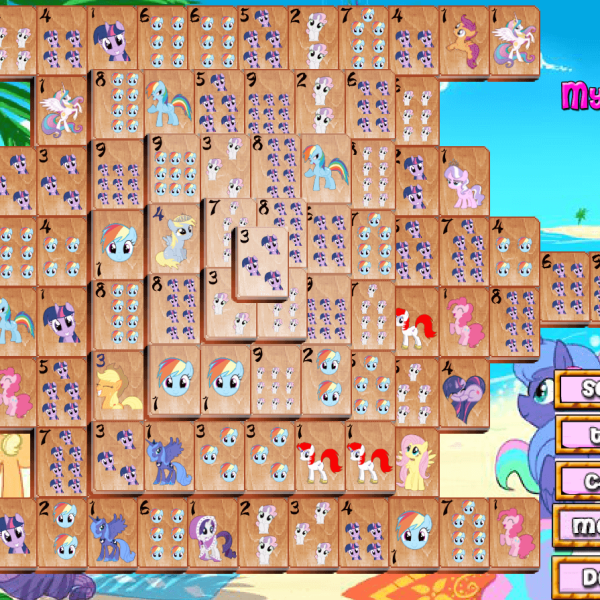
A solitaire layout is three or four tiles deep. The classic turtle has a spine along the middle, wings on either side and a single tile crowning the top, and every variant since has been a rearrangement of the same idea. Depth is the whole point: what you can see is not what you can take.
A connect board is one layer. Every tile is visible, every face is readable, and nothing is hidden underneath anything. The grid is often a plain rectangle, sometimes cut into a shape, and it usually sits under a timer bar that starts draining as soon as the level appears.
What makes a pair legal
In solitaire a tile is available when nothing rests on top of it and one of its long sides is unobstructed. Position is everything: a tile in the middle of a row is locked until the row is eaten from an end, and a tile under even a partial overlap is locked completely.
In connect, position is almost irrelevant and the route is everything. Two tiles clear when a path can be drawn between them that turns no more than twice and crosses only empty squares. The path can run outside the edge of the grid, which is why border tiles are usually the easiest to clear and the middle of a full board is usually the hardest. The site’s own example of it is Mahjong Link.
| Solitaire | Connect | |
|---|---|---|
| Layers | Three or four | One |
| What blocks a pair | Tiles above and beside it | Tiles in the way of the path |
| Clock | Usually none | Usually per level |
| Session | One board, five to fifteen minutes | Levels of one to three minutes |
| Losing | Board can seal itself | Board reshuffles instead |
What actually decides the outcome
Solitaire is decided by which of several available pairs you take. When four copies of a face are on the board and two are exposed, taking the wrong two can bury the other two permanently. The strong habit is to look for faces where three or four copies are free at once, clear those first, and treat any pair that opens a covered tile as more valuable than a pair that opens nothing.
Connect is decided by speed and by the order of clearing, not by the risk of a fatal choice. There is no wrong pair, because the board will reshuffle if it jams. What costs you a level is spending twenty seconds hunting for one connection when three obvious adjacent pairs were sitting in front of you. Clearing from the outside inwards widens the lanes for everything trapped in the centre, which is the closest thing the format has to strategy.
How a session ends
This is the practical difference. A solitaire board can be lost quietly. You will not notice at the moment it happens; you will notice fifteen moves later when nothing legal remains and the tiles that would have matched are stacked on top of each other. A shuffle button, where one exists, is the rescue, and using it usually costs points.
A connect level ends on the timer or on a completed grid, and never on a dead position, because the program reshuffles when no two-turn path exists anywhere. If losing without warning irritates you, that alone settles the question. If you find the reshuffle a bit of a let-down, so does the other side.
What the two formats ask of a screen
A stacked layout wants width and height. Four layers drawn in perspective mean the faces are already smaller than the tiles they represent, and a shrunken window pushes the lower rows past the point where a bamboo four and a bamboo five can be told apart at a glance. Full screen is not a luxury on those boards, it is what makes the back rows readable.
A connect grid is far more forgiving, because one flat layer can simply scale. That is why the format survives a phone screen while a turtle struggles on one, and why connect boards are the ones worth opening when the display is small or the sitting is on the move. Themes cut the same way: bold artwork on a flat grid reads instantly, while traditional suits stacked four deep are the hardest combination to scan quickly. A layout of that kind in the catalogue here is Butterfly Kyodai.
Which one to pick
Take solitaire if you want to think without being hurried, if you like a board that punishes carelessness, and if you have an open half hour. Take connect if you have a fixed few minutes, if you want a clean stopping point, and if you would rather be tested on reaction than on foresight.
If you are introducing someone else to the tiles, start with solitaire and its two conditions, because they can be explained in a sentence and demonstrated in one move. Bring in connect afterwards, since the two-turn path is the harder idea of the two and it lands better once pairing itself has become automatic.
Most people end up playing both for different moods, and the sections are separated for exactly that reason: the stacked layouts on one side, the flat connecting grids on the other. The Titans board is a plain example of the first, and the second Connect board a plain example of the other.
Two related pieces go deeper. The onet explainer unpacks the two-turn path rule properly, and the map of Mahjong types shows where both formats sit beside the cubes, the towers and the four-player table game they all borrowed their tiles from.