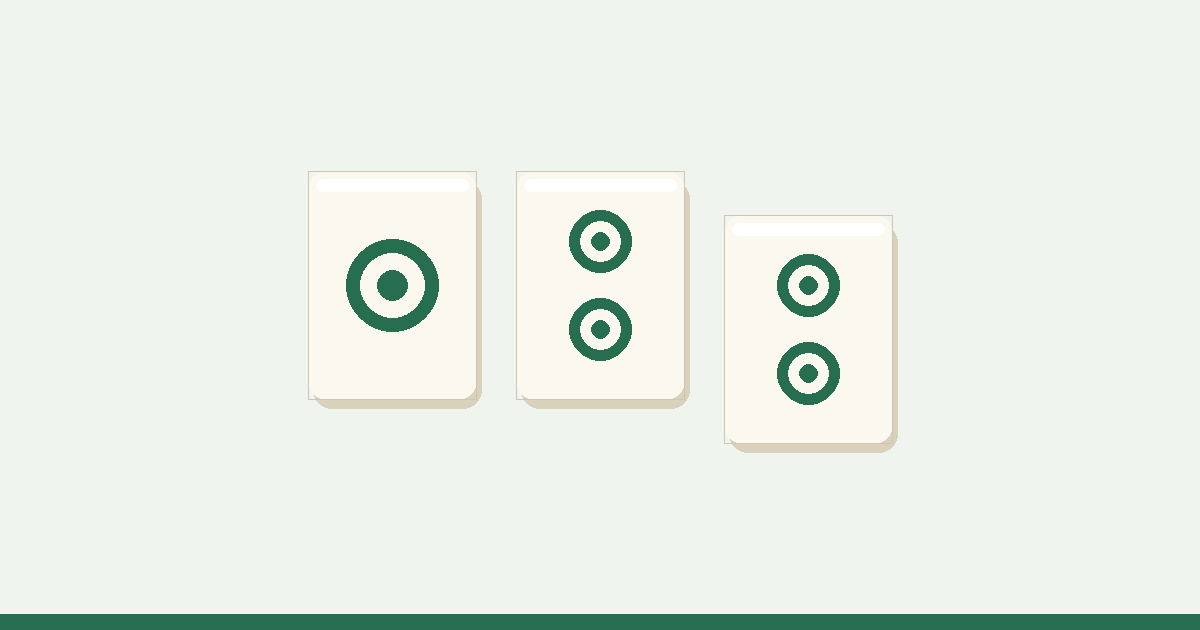
All four spellings are in use and none of them is wrong. The plain seven-letter form, Mahjong, is the modern standard and the one to type into a search box. Mah-Jongg with a hyphen and a doubled g is the older American form, still visible on club stationery and on rule books printed decades ago. Mahjongg without the hyphen belongs mostly to software titles. Majong, missing its h, started as a slip of the finger and has been repeated often enough to become a spelling people genuinely search with.
The variety is not carelessness. It is what happens when a Chinese name reaches English twice: once through travellers writing down what they heard, and once through a businessman who trademarked a spelling and made everybody else pick a different one.
The word was never English to begin with
In Chinese the game carries two names. In much of the north it is 麻將, transcribed today as majiang; in the south, and particularly in Cantonese-speaking areas, it is 麻雀, which literally means sparrow. Sources differ on which name came first, just as they differ on how old the game is; the middle of the nineteenth century is the most widely accepted window for its emergence, but it is a best reading of thin evidence rather than a settled date.
Westerners writing about the game in the 1910s and 1920s had no agreed system for putting Chinese sounds into Latin letters. Pinyin did not exist yet, Wade-Giles was inconsistently applied to a table game nobody had heard of, and each writer transcribed by ear. The second syllable came out as jong, jongg, jung and cheuk depending on which dialect the writer had been listening to and how good their ear was. The sparrow name is commonly given as the reason a bird appears on the one of bamboo, though that explanation is repeated more often than it is evidenced.
Babcock, the hyphen and the trademark
The version of the story that most accounts agree on runs like this. Joseph P. Babcock, an American working in China, wrote a simplified rulebook around 1920 for players who had no Chinese and no patience for regional scoring, and he exported both the rules and the sets. By 1923 the game was a full-blown craze in the United States. Babcock standardised on the hyphenated, doubled-g form Mah-Jongg and, according to the usual telling, protected it as a trademark.
That single decision is why the spelling never settled. Competitors selling sets and rulebooks into the same boom could not use his exact form, so they printed something else on the box: Mah Cheuk, Pung Chow, Ma-Chiang, Mah-Jong with one g. Within a couple of years half a dozen spellings were circulating in shops at the same time, and every one of them left descendants. What looks now like sloppiness in the dictionary is really a fossil record of a trademark dispute nobody remembers.
What each spelling signals today
- Mahjong — the plain modern default. English editions of Chinese and Japanese rule books use it, most websites use it, and it is the safest form for anything you write.
- Mahjongg — the doubled g without the hyphen. Software has kept this one alive: a good number of tile games shipped under it and still carry it, which is why our own catalogue holds pages such as Mahjongg Alchemy alongside titles spelled the plain way.
- Mah-Jongg — the Babcock form. It marks American club play and older books, and the National Mah Jongg League still spells its own name in that older style, though without the hyphen.
- Majong — a dropped h. Treat it as a misspelling rather than a variant, but a persistent one that turns up constantly in search boxes.
Which spelling to search with
For a general search any of them will do, because search engines have long since learned that the four forms mean the same thing and fold the results together. The exception is a specific title. Software names are matched far more literally, especially inside app stores, so if you are hunting a particular game the safe move is to spell it the way its makers spelled it. Our own catalogue is a small demonstration of the problem: Mahjongg Solitaire keeps its doubled g while Mahjong Titan does not, because that is how each one shipped.
One more practical note. If a search returns nothing useful, the fault is more often the second word than the first. The layouts people mean when they say the name vary enormously, and adding solitaire, connect or dimensions narrows things far more effectively than switching between spellings does; the solitaire section and the connect section hold two quite different games under one word.
How this site spells it
We use the plain form in prose and keep whatever spelling a game shipped with in its own title, which is why both appear across the catalogue. Nothing is corrected silently: renaming a game to tidy up the spelling would only make it harder to find. The catalogue has run since 2019, the layouts come in a range of shapes, the Flash-era titles run through the Ruffle emulator, and every board can be opened full screen.
The other words with two spellings
The name is not the only casualty of transliteration. The three claiming calls arrive in English through different dialects and different decades, which is why pung, kong and chow also appear as pon, kan and chi in books following Japanese rules. Riichi is sometimes written reach, which is not a translation but the same sound written by somebody who assumed it was English. And the single-player layout is still called Shanghai on some sites, after the computer game that popularised it in the 1980s rather than after anything Chinese. If a term looks unfamiliar, check the glossary before assuming it is a different concept — more often than not it is the same idea wearing another transcription. A layout of that kind in the catalogue here is Mahjong Gardens.