
Mahjong Hands and Scoring: Winning Hands, Points and Charts
On this page
Every school of four-player Mahjong agrees on what a hand is and disagrees on what it is worth. The shape of a winning hand, four sets and a pair, is the same in Hong Kong, Beijing, Tokyo and a National Mah Jongg League living room; the number written down afterwards can differ by a factor of a hundred. This page separates the two questions. The first half lists the hands themselves, from the plain four-sets-and-a-pair to the limit hands every rulebook names; the second half explains how each major school turns a hand into points, with links to the full rules of each. If the words pung, kong and chow are new, the guide to the three sets is the place to start.
What a winning hand is
A standard hand is fourteen tiles arranged as four sets and one pair. A set is a pung (three identical tiles), a kong (four identical tiles, which still counts as one set) or a chow (three consecutive tiles of one suit). The pair, sometimes called the eyes, is two identical tiles. You hold thirteen tiles between turns and go out on the fourteenth, whether you draw it from the wall or claim it from a discard. Most of the time that is all a winning hand needs to be: the sets can be any mix of pungs and chows, the pair can be anything, and the hand is called a chicken hand in Hong Kong because it has no pattern at all.
Two hands break the four-sets-and-a-pair rule and almost every school accepts at least one of them. Seven Pairs is exactly what it says, seven different pairs with no sets. Thirteen Orphans is one of each terminal (the 1 and 9 of every suit), one of each wind, one of each dragon, and one more of any of those thirteen as the pair. Beyond these, hands differ by pattern, and pattern is what scoring rewards.
The standard hands and what they look like
Names drift between rulebooks, but the shapes below appear, under some name, in Hong Kong, Chinese Official, riichi and most house rules. American Mah Jongg is the exception: its legal hands are printed on a card that changes every year, and it is covered separately below.
| Hand | Shape | Where it sits |
|---|---|---|
| All Chows (Pinfu in riichi) | Four chows and a non-honour pair | Cheapest patterned hand |
| All Pungs | Four pungs or kongs and a pair | Low to mid value everywhere |
| Half Flush | One suit plus honours only | Mid value |
| Full Flush | One suit only, no honours | High value |
| Little Three Dragons | Two dragon pungs and a pair of the third | High value |
| Big Three Dragons | Three dragon pungs | Limit hand |
| Little Four Winds | Three wind pungs and a pair of the fourth | High value |
| Big Four Winds | Four wind pungs | Limit hand |
| All Honours | Only winds and dragons | Limit hand in most schools |
| All Terminals | Only 1s and 9s | Limit hand in most schools |
| Seven Pairs | Seven distinct pairs | Mid value where allowed |
| Thirteen Orphans | One of each terminal and honour, plus a duplicate | Limit hand |
| Nine Gates | 1112345678999 of one suit, concealed, plus any tile of that suit | Limit hand |
| Four Kongs | Four kongs and a pair | Limit hand |
| Heavenly Hand | Dealer wins on the initial deal | Limit hand |
| Earthly Hand | Non-dealer wins on the dealer’s first discard | Limit hand |
A limit hand is one that pays the maximum the table allows, however the rest of it is counted. Where the limit sits is a house decision: thirteen faan in traditional Hong Kong play, 88 points in Chinese Official rules, a yakuman of 32,000 points in riichi. The easiest hands to actually complete are the ones with no suit restriction, All Chows and the chicken hand, and most beginners win their first games with exactly those.
Concealed, dead and chicken hands
Three terms come up in every scoring argument. A concealed hand (closed hand, menzen in Japanese) is one you completed without claiming any discard for a set; the only tile allowed to come from another player is the winning tile itself, and in some schools not even that. Staying concealed is rewarded almost everywhere: an extra faan in Hong Kong, access to riichi and several yaku in Japan, a higher value for most concealed hands on the American card. A dead hand is the opposite of a bonus. In American Mah Jongg a hand is declared dead when it can no longer win: too many or too few tiles, an exposure that matches no hand on the card, or a called tile that was never legal. The player keeps discarding but cannot win or call, and the hand is settled without them. A chicken hand is the Hong Kong name for a hand with no scoring pattern at all; under the usual three-faan minimum it cannot be declared, which is why Hong Kong players spend the middle of a hand building toward a pattern rather than toward the fastest possible out.
How the schools count: faan, points, han and the card
Scoring is where the schools part company, and the honest summary is that each one is a different system rather than a different scale of the same system.
Hong Kong: faan and a doubling table
Each pattern in the hand earns faan: three for All Pungs or a Half Flush, seven for a Full Flush, one each for a dragon pung, a seat-wind pung or a self-drawn win, and so on. The faan are added, the total is looked up in a doubling table (a common table runs 3 faan = 8 base points, 4 = 16, 5 = 24, 6 = 32, 7 = 48, 8 = 64, and the limit at 13), and the base is paid by the discarder, or by everyone on a self-draw. A table sets its minimum before play, usually three faan. The Hong Kong rules and scoring guide walks the counting through a complete hand.
Chinese Official rules: 81 patterns, eight-point minimum
The competition rules used in international tournaments list 81 scoring patterns worth from 1 to 88 points and require a hand to reach at least eight points before it can be declared. Patterns stack, with a rule against counting a smaller pattern that is implied by a larger one. Payment is flat: the winner receives the hand’s value plus eight from the discarder and eight from each other player, or the value plus eight from everyone on a self-draw. The Chinese Mahjong rules walkthrough covers the turn structure this scoring sits on.
Riichi: yaku, han, fu and the limit ladder
A Japanese hand must contain at least one yaku, a named pattern, before it can win at all. Each yaku is worth a number of han (riichi itself, tanyao and a dragon pung are one han each; seven pairs two; a half flush three; a full flush six), and dora bonus tiles add han without being yaku. The han total and a count of fu, small points for the shape of the sets, give a base score that is then rounded up a ladder: a mangan of 8,000 points at five han, a haneman of 12,000, a baiman of 16,000, a sanbaiman of 24,000 and a yakuman of 32,000 for the limit hands, with the dealer collecting half as much again. The riichi primer explains yaku, dora and furiten in full.
American Mah Jongg: the card decides
There is no pattern list to memorise, because the National Mah Jongg League prints the legal hands on a new card each year with a value next to each, from 25 points for the common hands to 75 for the hardest. A concealed version of a hand is worth more than the exposed one, and winning without a joker doubles the value. Payment follows the winning tile: if it was discarded, the discarder pays double and the other two pay the face value; if the winner picked it from the wall, everyone pays double. The American rules walkthrough and the basics of the card, jokers and Charleston cover the rest.
A scoring chart for the common hands
The values below are the headline numbers from each school for a hand completed with nothing else counting. They are a reading aid, not a substitute for the table’s own sheet: Hong Kong tables use several different doubling tables, riichi adds dora and fu, and the American card changes every year.
| Hand | Hong Kong (faan) | Chinese Official (points) | Riichi (han) |
|---|---|---|---|
| All Chows / Pinfu | 1 | 2 (as All Chows) | 1, concealed only |
| All Pungs | 3 | 6 | 2 |
| Half Flush | 3 | 6 | 3 (2 if open) |
| Full Flush | 7 | 24 | 6 (5 if open) |
| Seven Pairs | not standard | 24 | 2 |
| Little Three Dragons | 5 | 64 | 2 plus the dragon pungs |
| Big Three Dragons | limit | 88 | yakuman |
| Thirteen Orphans | limit | 88 | yakuman |
| Nine Gates | limit | 88 | yakuman |
| Four Kongs | limit | 88 | yakuman |
| All Honours | limit | 64 | yakuman |
Sticks, coins and sheets
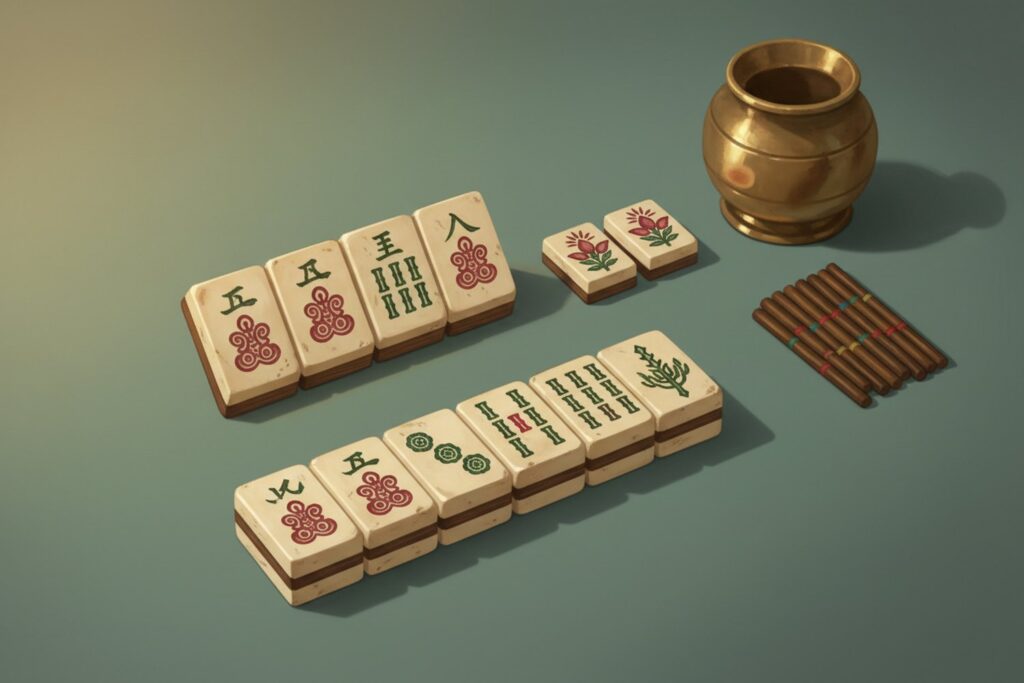
Riichi sets come with scoring sticks, thin bars marked for 10,000, 5,000, 1,000 and 100 points; each player starts with a stack worth 25,000 and settlements are made in sticks rather than written down, with a 1,000-point stick placed on the table to declare riichi. Chinese and Hong Kong tables historically used chips or coins and today mostly keep a running sheet, one column per player, totals carried hand to hand. American tables settle in chips or on paper from the values printed on the card. Whatever the method, the habit that saves the most arguments is counting the hand aloud before anything is paid: name each pattern, add it up, and let the table agree before the tiles are mixed.
Where to go next
The sets themselves are covered in pung, kong and chow explained, the vocabulary in the Mahjong glossary, and the family tree of the schools in types of Mahjong. If you want to practise recognising sets and pairs without three opponents, the solo boards on this site use the same tiles: the Mahjong solitaire section and the classic layouts are the quickest way to learn the suits by sight.
Frequently asked questions
What is a winning hand in Mahjong?
Fourteen tiles arranged as four sets (pungs, kongs or chows) and one pair. Seven Pairs and Thirteen Orphans are the two standard exceptions, and most schools also require the hand to reach a minimum value before it can be declared.
What is a concealed hand in Mahjong?
A hand completed without claiming any discard for a set. It earns a bonus in every school: extra faan in Hong Kong, the right to declare riichi in Japan, a higher value on the American card.
What is a dead hand in Mahjong?
An American Mah Jongg term for a hand that can no longer win, usually because it holds the wrong number of tiles or shows an exposure that matches nothing on the card. The player keeps discarding but is out of the hand.
How does Mahjong scoring work?
Each school lists patterns and gives each a value: faan in Hong Kong, points in Chinese Official rules, han in riichi, a printed value per hand in American Mah Jongg. The patterns in a winning hand are added, a minimum must be met, and the discarder usually pays more than the other players.
What is the easiest Mahjong hand to make?
A hand with no suit restriction: four chows and a pair, or any mix of chows and pungs. In Hong Kong that chicken hand needs an extra pattern to reach the three-faan minimum, and in riichi it needs one yaku, which is why a dragon pung or an all-simples hand is the usual beginner’s route.
To put the scoring to use at an actual table, real Mahjong online lists where the four-player game is played against the computer and against people.