Four people, a flat surface and 144 tiles will get a game going. Everything else on the list below exists to remove bookkeeping from the players and hand it to an object, which is why a table set that has been in use for decades tends to accumulate small tools rather than shed them.
Here is what sits on the table in a traditional game, what each item is for, and what the pieces themselves are made of. No purchasing advice follows; the aim is to let you look at a set and understand what you are looking at.
The tiles
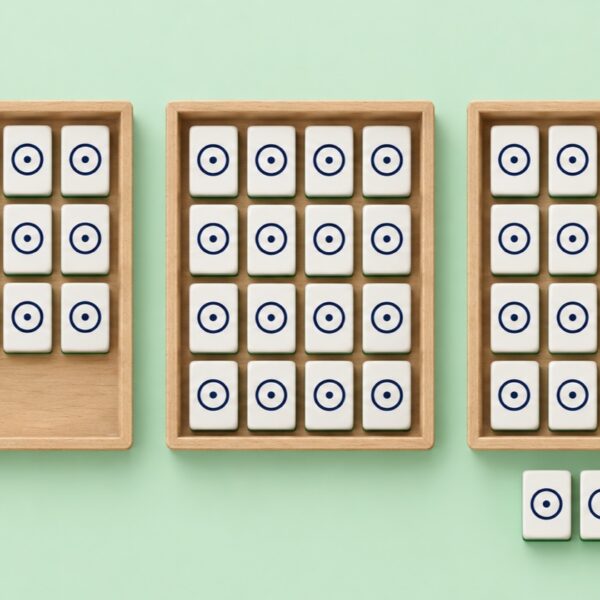
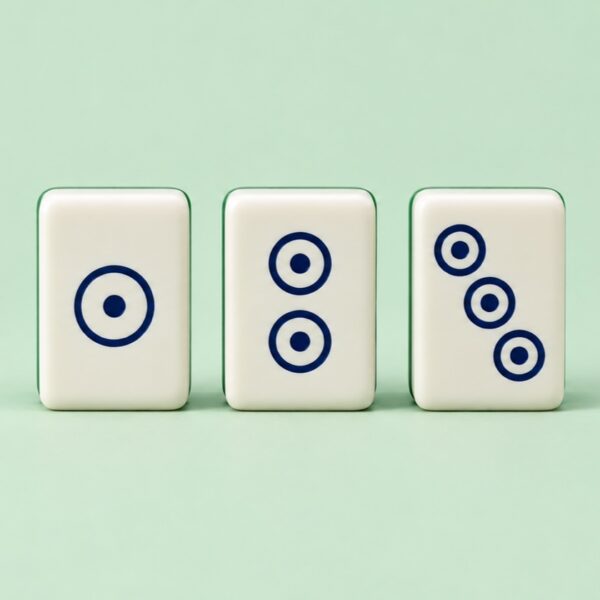
The set is the equipment. A Chinese one holds 144 pieces – three suits of 36, sixteen winds, twelve dragons, eight flowers and seasons – and the composition of those 144 determines almost everything else on the table, because the wall is built from them and the wall is the clock of the game.
Sizes vary more than people expect. Small Chinese travelling tiles run about 20 mm across the face, standard ones nearer 26 mm, and Japanese riichi tiles are larger and considerably deeper. Depth matters as much as width: a tile needs enough body to stand unaided when the wall is built two courses high, and a thin tile will topple a wall that a thick one holds.
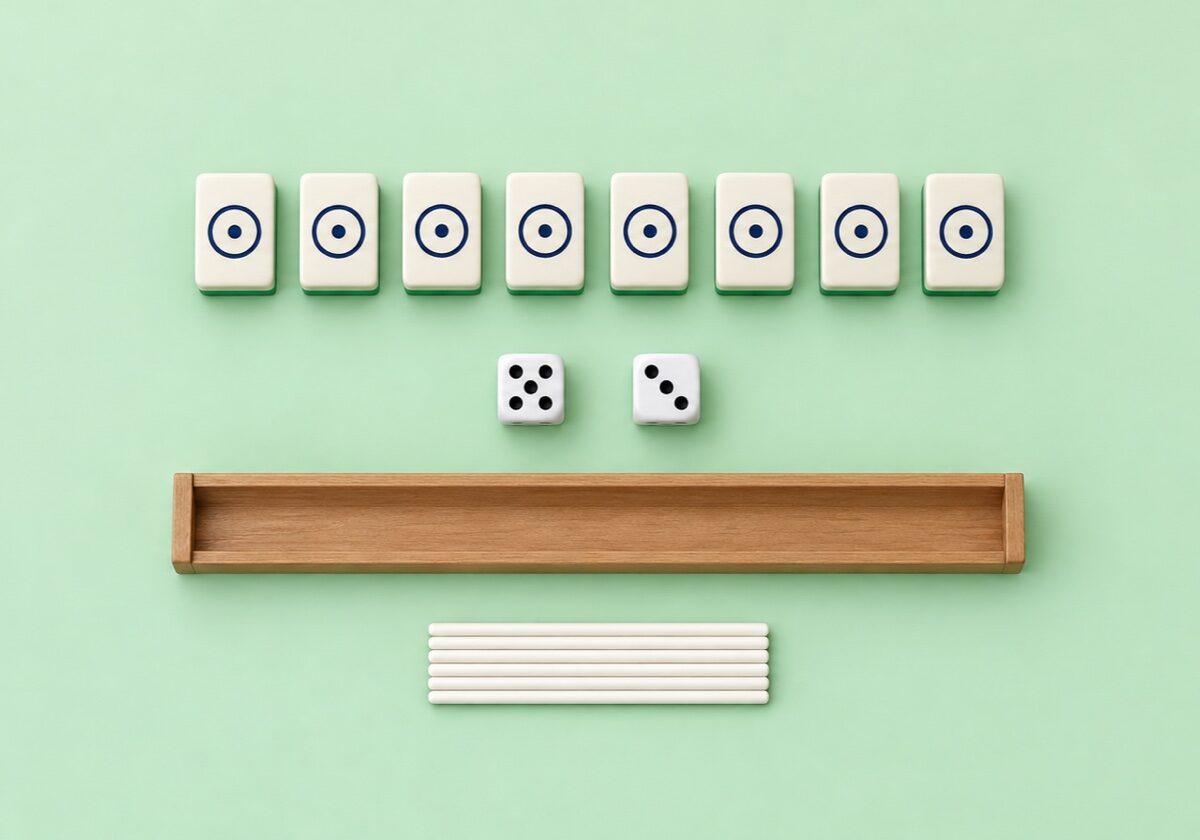
Dice
Two dice are standard and some traditions use three. They decide where the wall is broken for the deal, which is the one moment of pure chance before any decision is made. The dealer throws, counts round the seats to find which player’s wall is opened, and counts again along that wall to find the exact break point. The site’s own example of it is Mahjong Deluxe.
The point of the ritual is not superstition but security: nobody can predict which tiles they will receive, even having watched the wall being built. Dice for this purpose are small, often 8 or 10 mm, sized so they can be thrown inside the ring of walls without knocking one over.
Racks and pushers
A rack is a sloped ledge that holds a hand of thirteen tiles upright and hidden from the other three players. It saves the wrists, keeps a hand from collapsing when somebody knocks the table, and makes a hand faster to reorder.
A pusher is a rack with a long straight arm attached, used to shove a completed row of wall forward into the square. Racks and pushers are strongly associated with the American game, where thirteen tiles plus jokers make for a wide hand, and are less common in Chinese play, where hands are often simply stood on the felt.
Counting sticks and chips
Payments happen constantly during play, so the score is carried in tokens rather than written down. Chinese sets traditionally use bone or plastic counting sticks marked with coloured dots at different values, and Japanese sets use flat point sticks in denominations that are read by the pattern of pips.
Chips and small denominational plaques appear in other traditions. Whatever the form, the principle is identical: every player starts with an equal stack, settlement is immediate after each hand, and the stack in front of a player is the running score. A pen and paper does the same job and is used in plenty of casual games, but it slows the settlement between hands to a crawl. The Mah-Jongg Key is one of the layouts kept on this site.
The wind indicator
Two things must be remembered at all times: who is currently dealing, and which round is being played. A wind indicator handles both. It is usually a small marker or a rotating disc showing the prevailing wind, parked in front of the East seat, and it moves with the deal.
Sets solve it differently – a marked plaque, a rotating cube in a stand, or four spare wind tiles drawn to allocate seats at the start. Cheap sets often omit the indicator entirely, which is the most common reason a casual table loses track of the round and argues about scoring three hands later.
The table
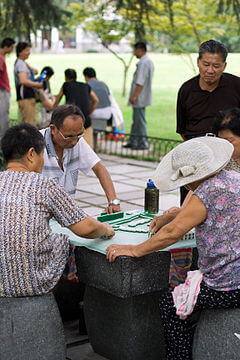
A green felt cloth is the minimum, and it earns its place: it deadens the noise of tiles being shuffled face down, stops them sliding, and lets a player lift one with a fingernail. A bare wooden table makes shuffling loud enough to be unpleasant and hard on the tile edges.
Dedicated tables are square, sized so four walls of eighteen stacks fit inside comfortably, and often have recessed corners for counting sticks and drinks. Automatic tables shuffle and build the walls mechanically inside the table body, delivering a finished wall through the surface; they are ordinary in mahjong parlours and rare in homes. Number Mahjong puts that layout on a playable board.
What tiles are made of
Early sets were bone laminated onto a bamboo back, the two pieces pinned or glued, which is why very old tiles show a visible seam along the side and a warm off-white face. Bone gave way to celluloid and then to catalin and bakelite in the early twentieth century, and those vintage plastics have a distinctive weight and a faint smell that collectors use for dating.
Modern tiles are moulded from melamine, urea resin or ABS. They are dimensionally consistent, they do not yellow, and they take a printed or engraved face equally well. A modern resin tile is the reason a set can be replaced piece by piece at all, since bone and bamboo could never be matched exactly.
What separates a plain set from an elaborate one
- Engraving depth – a face carved into the tile and then filled with colour survives decades of shuffling; a face printed on the surface wears at the edges first.
- Hand finishing – the bird on one bamboo and the eight painted bonus tiles are where hand work shows, and where a mass-produced set looks flattest.
- Weight and feel – heavier tiles stack into a steadier wall and make the characteristic sound; light hollow ones skitter.
- Back colour – traditional sets use a single consistent back, usually green, yellow or ivory. Any variation between backs is a defect, because it makes tiles identifiable face down.
- The case – a fitted wooden or leather box with drawers keeps a set sorted and countable, which matters more over years than any decoration on the faces.
What you can leave out
Racks, pushers and an automatic table are conveniences. Dice and some means of tracking score and prevailing wind are not, because the deal and the settlement depend on them. If a set arrives without an indicator, four spare wind tiles do the job.
None of this applies to a solitaire layout, where the software holds the score, the wall and the wind. That is the real difference between the table game and the screen version: the equipment list collapses to nothing, and what survives is the tile faces themselves, which is why the skill of reading suits and honours quickly carries over intact to the layouts in the catalogue. A layout of that kind in the catalogue here is Mahjong Impossible.