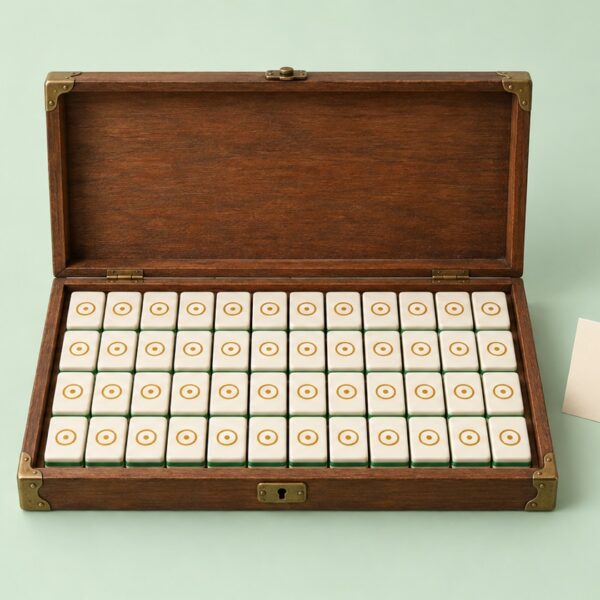
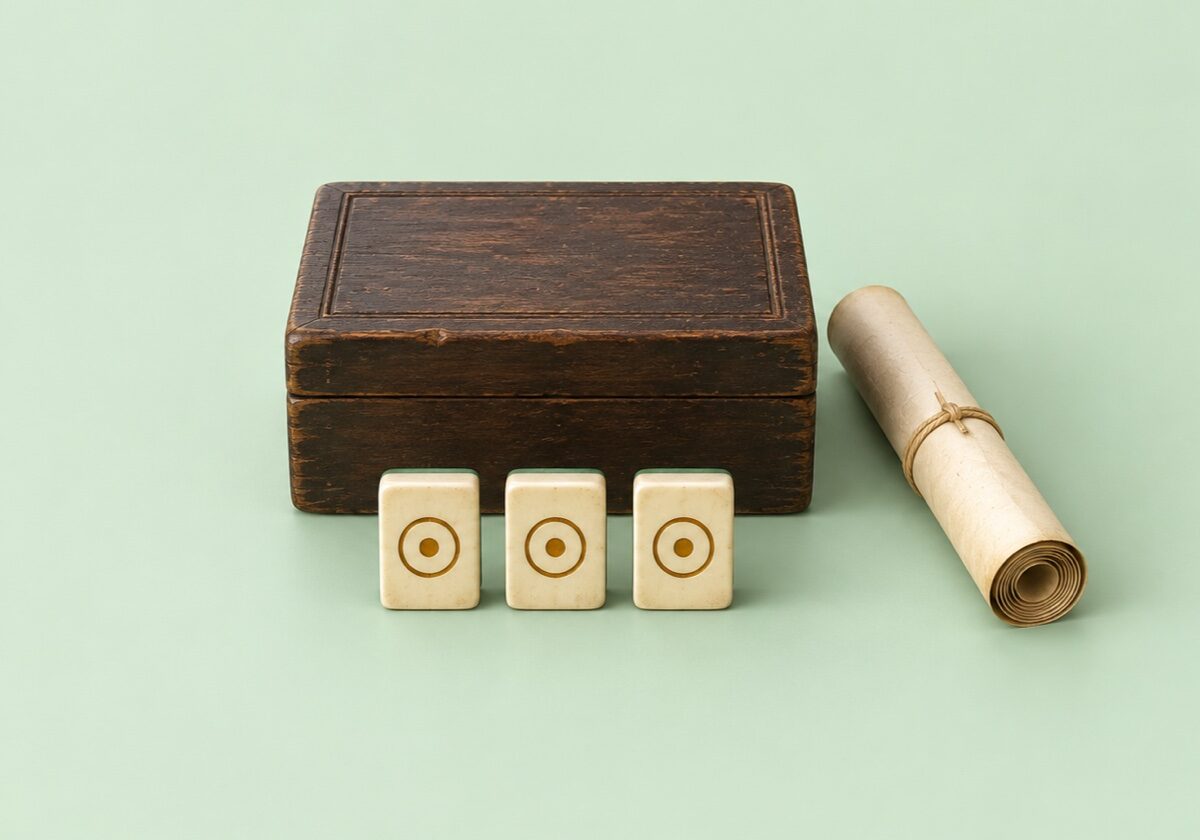
Mahjong took its present shape as a four-player tile game in the Yangtze delta some time around the middle of the nineteenth century. That is the mainstream account rather than a documented date, and the difference is worth stating at the top of a page like this: no contemporary source names an inventor, a year, or a first game. What survives is a handful of late-Qing references, the tiles themselves, and a great deal of story told afterwards.

What the record can settle, and what it cannot
Three claims are supported well enough that specialists argue only over the detail. Geography: the earliest credible mentions cluster around Ningbo, Shanghai, Suzhou and Hangzhou, the trading cities of the lower Yangtze. Timing: those mentions belong to the second half of the nineteenth century, not to antiquity. Descent: the suits carved on the tiles are the suits of older Chinese money cards, which makes the set a physical rendering of a card game rather than an invention from nothing.
Almost everything else a reader wants is open. Who first moved the deck onto tiles, whether flowers and seasons belonged to the early sets or arrived later as ornament, how fast the rules travelled inland, why one delta city scored a hand differently from the next one along the river: none of that is settled, and careful accounts disagree with each other. Where they disagree, this page says so instead of choosing a winner and printing it as fact.
The Yangtze delta account
The version most historians work from runs like this. Between roughly 1850 and 1870, in the delta ports, a money-suited card game was transferred onto small tiles of bone backed with bamboo. Tiles suited the setting. They survive damp river summers better than paper, they can be shuffled face down without anyone reading a bent corner, and they make the clatter that later supplied the game with half of its nicknames. From the delta it moved along the trade routes: upriver, down the coast, and outward in the luggage of emigrants.
Two anecdotes attach themselves to this account, and both are anecdotes rather than evidence. One has garrison officers playing through their idle hours on service; the other has the game circulating in merchant households in the suburbs of Shanghai before it reached the street. They are consistent with the geography, which is as much as can fairly be claimed for them.
Sets of that period were not standard objects. Tile counts varied, flowers were present in some and absent from others, and scoring was a house matter agreed before play rather than a published system. Standardisation arrived with print, and print arrived late.
That late arrival is itself a useful check on the dating. The earliest detailed Chinese descriptions of play belong to the early twentieth century, written when the game was already widespread and worth explaining to outsiders, and nobody writes a rulebook for a pastime that has not yet spread. Anyone offering you a rule from the 1700s is offering a reconstruction, however plausible it sounds on the page.
Before the tiles there were cards
The best evidence for descent is sitting on the tiles in plain sight. Chinese money-suited cards counted in cash, strings of cash and myriads: a coin, a hundred coins threaded on a string, ten thousand as the unit above that. Those three denominations are the three suits. A circle is a coin, a bamboo is a string of them, and the character tiles still carry the sign for ten thousand under the numeral. Ma Diao, played with money cards from the Ming period onward, is the usual candidate ancestor, though the line from it to the tile game runs through several other card games and cannot honestly be drawn as one arrow. The tile-by-tile account of the suits and honours follows that inheritance in detail.
Legends, and why they keep being told
Several origin stories circulate in the same paragraph as the dated ones, which is how they acquire an authority they never earned. They are folklore. Naming them as folklore is not the same as dismissing them, because each says something about how the game has been valued.
- Confucius gives the game to the philosopher around 500 BC, reads the three dragon tiles as three virtues, and explains the sparrow name by his fondness for birds. There is no evidence for any part of it, the tiles postdate him by more than two thousand years, and the retelling that promotes Confucius to emperor gets his life wrong as well.
- The flood has the game played aboard the ark, with the east wind leading because an east wind happened to be blowing. It is a folk explanation of a seating rule, reasoned backwards from the rule it explains.
- The fishermen invented tiles to fill long hours at sea and to keep the crew from seasickness. Popular, undocumented, and pleasing enough to survive endless retelling.
- The thousand-year game, usually pinned to the Song dynasty, rests on no contemporary source and sits badly with the card evidence that the tiles themselves carry.
The pattern is familiar from other pastimes: a diversion becomes respectable, and a suitably ancient pedigree is supplied for it after the fact.
The name, and what it might mean
Two written forms compete. One reads as sparrow; the other is the form standard Mandarin uses today. Explanations for the bird are rivals rather than a single story: that the clatter of tiles being washed across a table sounds like a flock of sparrows quarrelling, that the bird engraved on the one of bamboo lent its name to the whole set, or that a regional word was reinterpreted once the game left the region that coined it. Sources pick different favourites and none of them can prove the choice. The romanisations multiplied later in the West, which is why one game is spelled several ways on the same bookshelf, and the spelling question has a history of its own.
How it spread across Asia
Because the game is young, its spread is late and comparatively easy to follow. It moved first through the treaty ports and the coastal cities, which had the traffic and the mixed populations to carry a fashion; then along the emigration routes into Southeast Asia, where Chinese communities in Singapore, Penang and Manila were playing it by the early twentieth century; then into Japan and Korea, each of which took the tiles and rebuilt the rules around local habits. Every stop added something and dropped something else. The suits stayed put, flower tiles came and went, and the scoring diverged so far that a Cantonese player and a Japanese player today share the equipment and very little else. That divergence is not decay from a pure original, because there was no pure original to decay from: what travelled was a young game with a loose rule set, and each region finished it in its own way. The resulting family tree is laid out in the survey of the main variants. Mahjong Firefly is one of the layouts kept on this site.
1895: the first notice in the West
The earliest Western reference usually cited belongs to William Henry Wilkinson, a British consular official who studied Chinese playing cards and noted a game whose name he took down by ear rather than read on a page. He recorded the name and not the rules, which is why the citation proves contact and tells us nothing about how anyone played. For a Western reader that thin note is the entire record until the 1920s, when the game arrived with a marketing budget behind it.
The 1920s, when the game acquired a supply chain
American importers found it shortly after the First World War. Abercrombie and Fitch, then a sporting goods house, is generally credited with the first sets sold in quantity in the United States, with buyers dispatched to China to acquire whatever they could find, classic or not; the first run is often given as around twelve thousand. Demand outran the stock of old sets almost immediately, and workshops were expanded to feed it.
Rules were the harder import. Joseph Park Babcock, an American engineer working in China, published a simplified rulebook in 1920 and added Arabic numerals to the faces of export tiles so that a buyer who read no Chinese could tell a four of characters from a seven. His simplifications made the craze possible and did not survive him intact. Rival rule sheets followed, arguments followed the sheets, and the fashion collapsed nearly as fast as it had arrived, leaving behind a durable American game with institutions of its own. That story is told properly in the account of how the game settled in the West.
Bans, silence and return
After 1949 the game was suppressed in the People’s Republic. The objection was never to tiles but to what came with them: stakes, the merchant households the game was associated with, and hours the new state counted as unproductive. Play continued privately through those decades, which is one reason older regional styles came through the period at all rather than being flattened by a single official version. Restrictions eased with the reforms that began in the late 1970s, and by the end of the 1990s Chinese sporting bodies were issuing competition rules for a stakes-free tournament form. Other documented episodes from the game’s twentieth century follow the same shape: prohibition, private survival, official rehabilitation.
Japan builds a different game
The game reached Japan early in the twentieth century and parlours multiplied there through the 1920s. What grew out of that is not a dialect of the Chinese game but a distinct one, with its own vocabulary of declared ready hands, bonus indicators turned at the start of a hand, and a rule that penalises a player for having passed up a winning tile earlier in the same hand. The postwar decades gave it professional leagues, a publishing industry, and, from the late 1970s onward, automatic tables that shuffle and stack the wall underneath the playing surface. The Japanese ruleset repays separate study, because reading it as a variant of the Chinese game walks a beginner straight into its traps. The site’s own example of it is Mahjong Duels.
Where the tile puzzle came from
The single-player game most Western players meet first is a twentieth-century computer invention that borrowed the tiles and left everything else behind. It is usually traced to a program written by Brodie Lockard in 1981 for the PLATO system, and then to the 1986 release that put a turtle-shaped pile on office machines everywhere. The rules have no relation to the four-player game: no hands, no draws from a wall, no opponents, only free tiles matched in pairs until the pile clears or locks solid. Anyone who has cleared a turtle and nothing else will find the older game unrecognisable, which is the point of the short explanation of what the original actually is. The solitaire layouts in this catalogue, and boards such as Mahjong Titan, descend from that 1980s line rather than from the delta. A layout of that kind in the catalogue here is Marine Mahjong.
The digital century, including its dead ends
Browser play arrived in the 2000s on Flash, which is why so many well-remembered boards stopped working the year browsers dropped the plugin. Emulation brought part of that shelf back: the Flash classics kept here run through Ruffle, with the rough edges emulation implies for sound and timing. This catalogue has been collecting layouts since 2019, and the note on how the site was rebuilt covers what changed for the boards themselves.
How to read a claim about this history
Three questions settle most of the arguments you will meet online. Does the claim distinguish the four-player game from the tile puzzle, or does it swap one for the other halfway through a paragraph. Does it give a date with a range and a reason, or a single suspiciously round number. Does it name a source that could be checked, or does it open with the words it is said. The screen record is a separate business again, because what cinema did with the game shaped its popular image far more than any rulebook ever did.
The same three questions work on the objects. A set with Arabic numerals on the character tiles is an export set or a descendant of one rather than evidence of an ancient tradition, and a dealer’s claim that a bone-and-bamboo set is two centuries old is a claim about carving rather than about the game, since both materials were in use long before anyone stacked them into walls. Provenance for tiles is as thin as provenance for dates, and for the same reason: this was an ordinary object that nobody thought worth documenting until it became fashionable.