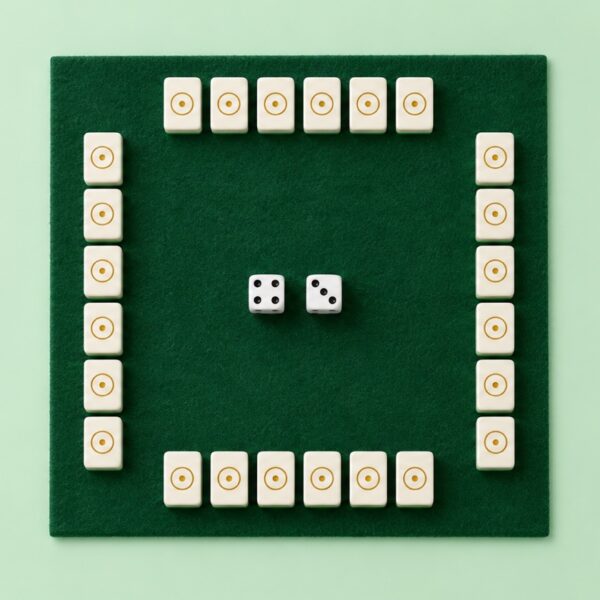

Card games photograph badly and tile games photograph well. Four faces around a square table, thirteen tiles hidden from three of them, one discard that everybody in the room reads differently: a director gets a hierarchy, an argument and a secret in a single shot with no exposition. That is why the table keeps appearing in Chinese-language cinema, and the ten films below put it to ten different uses.
Why the table works on screen
The game is commonly said to have shown up in Chinese films as early as the 1920s and 1930s as background texture, and to have become a fixture of Hong Kong cinema from the 1960s onward. Whatever the exact chronology, the reason it stuck is mechanical. The seating is a diagram of rank, since East deals and the other three sit in relation to that. The wall gives a scene a visible clock, because everyone can see how many tiles are left. The discard hands a character a decision the audience watches being made even when they cannot read a single face. And since stakes have followed the game nearly everywhere it has travelled, a table can carry money, debt and family obligation without a line of dialogue naming any of them. The site’s own example of it is Mahjong Relax.
The ten films, in order
The Joy Luck Club (1993)
Wayne Wang’s adaptation is the film that made the table legible to Western audiences. The club of the title is a Mahjong club, four women who have been meeting to play for decades, and the stories arrive between hands rather than around them. When June takes the seat her late mother left at the east corner, the geometry does the work: the empty chair, the daughter filling it, the aunties watching to see whether she understands what that particular seat means. The tiles are never explained and never need to be.
The Grandmaster (2013)
Wong Kar-wai’s Ip Man film is assembled out of interiors where business is conducted sideways, and the gaming rooms are among them. Tiles here are the furniture of a world in which martial arts houses settle questions of succession and face without stating anything outright, shot the way Wong shoots everything: close, partial, through smoke and lamplight. The game supplies atmosphere and a social map rather than a plot mechanism, which is a legitimate use of it.
Indecent Proposal (1993)
Adrian Lyne’s film is the outlier here and worth being straight about: its gambling happens on a Las Vegas casino floor, not at a tile table. It earns a place on lists like this one for its premise rather than its props, because a single wager rearranging a marriage is the oldest anxiety attached to the game, transplanted to Nevada and given a billionaire. Watched as a study of what a bet does to the two people who accept it, the connection makes perfect sense.
Crazy Rich Asians (2018)
Jon M. Chu’s film, adapted by Peter Chiarelli and Adele Lim from Kevin Kwan’s 2013 novel, contains the best-known scene of the last decade. Rachel arranges to meet Nick’s mother in a parlour and plays the entire confrontation through the tiles: she works out what Eleanor is waiting for, holds it, and then discards it deliberately so the older woman wins the hand she was never going to be allowed to lose. The concession is the argument. A viewer who does not play sees a polite game; a viewer who does sees a winning hand thrown away to make a point.
The Man from Macau (2014)
Wong Jing’s gambling caper, with Chow Yun-fat as a retired prodigy pulled back in to get his goddaughter away from a crime boss, treats every game as a set piece and the tile table as one more arena for the genre’s favourite trick, the impossible read performed with a straight face. It belongs squarely to the Hong Kong tradition in which gambling skill is a superpower and the camera watches hands rather than faces.
All’s Well, Ends Well (1992)
Clifton Ko’s Lunar New Year comedy uses the table the way the holiday does, as the place where the family assembles and its frictions get aired in public. The game is a plot device in a farce about a man being steered towards a wife by his mother, and the comedy comes from the manners around the table rather than the tiles: who sits where, who is entitled to comment on a discard, and who is losing money while pretending not to mind.
God of Gamblers (1989)
The film that set the template Wong Jing would work for the next twenty years. A gambling genius loses his memory after an attack and has to be reassembled into himself, and the pleasure of the thing is watching a man who cannot recall his own name still know exactly which tile is about to turn up. Genre convention treats that instinct as a form of martial art, and the gaming sequences are choreographed on exactly that principle.
Mahjong Dragon (1997)
Tony Au’s Hong Kong entry puts the game in its title and a high-stakes tournament at its centre, which makes it one of the few films here where a viewer who knows the rules gets more out of the sequences than one who does not. The tension is built out of what players decline to do: the tiles they refuse to release when the safe discard would cost them the hand they have spent the round assembling. Microsoft Mahjong puts that layout on a playable board.
The King of Mahjong (2015)
Adrian Teh’s comedy follows the standard sporting shape, with a retired champion drawn back to defend his title against a younger challenger and the tile table standing in for the ring. It leans on the same convention as the Hong Kong gambling pictures, that reading a table is a talent bordering on the supernatural, but plays it for laughs and family reconciliation rather than menace.
Love Undercover 2: Love Mission (2003)
Joe Ma’s sequel sends its accident-prone policewoman undercover at the tiles to get close to a gang of robbers, and the joke writes itself: an officer who has to lose convincingly, in a game where losing convincingly is harder than winning. The scenes work as comedy of incompetence, and they only land because the audience knows enough about the game to watch her getting it wrong.
What the films get right, and what they exaggerate
Three things recur across the list and all three are true to life. The table is social before it is competitive. The discard is where information leaks. And money, once it is on the table, changes how people speak to each other. The exaggeration is the reading: cinema loves a player who knows the wall the way a card counter knows a shoe, and real play offers nothing that clean. You track discards, you weigh what an opponent has passed up, and you are wrong regularly. The symbolism the genre attaches to the game, with gambling, deception and betrayal all seated at the family table, is a real cultural association rather than a screenwriter’s invention, which is why it reads instantly even to audiences who have never touched a tile. A layout of that kind in the catalogue here is Coffee Mahjong.
Watching with the rules in mind
Two of these films, the parlour confrontation in Crazy Rich Asians and the tournament in Mahjong Dragon, repay a viewer who knows what a hand is and why one discard differs from another, and that is twenty minutes of reading rather than a course. The short version of the rules covers the four-player game; the history behind the table explains why stakes and this game have been bound together for so long. If the films leave you wanting tiles rather than plot, the solitaire layouts here are a different game entirely, and the documented oddities of the last century make better company than the legends. Whether the habit does anything for the mind has a more careful answer than the internet usually offers. Super Mario Mahjong is one of the layouts kept on this site.