

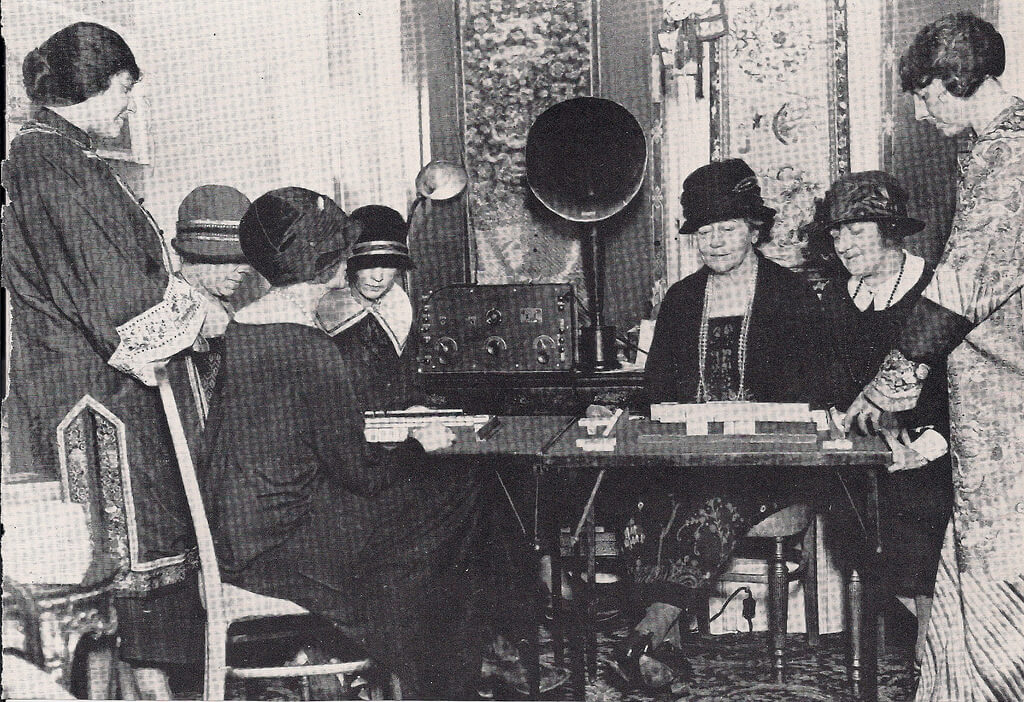
The Western stereotype is very specific: four older women at a card table with a printed hand card propped between them. It is not inaccurate, and it is not the whole picture either. It is a residue, the thing left standing after a national craze burned through the United States in roughly three years and left exactly one durable institution behind it.
1895, and then a quarter century of nothing
The earliest Western notice generally cited belongs to William Henry Wilkinson, a British consular official and student of Chinese playing cards, who took down the name of a tile game by ear without recording how it was played. That note proves contact and no more. For twenty-five years afterwards the game stayed where it was, and nothing in the English-language record suggests anyone in the West was playing it.
Abercrombie and Fitch, and twelve thousand sets
Then came the importers. Abercrombie and Fitch, at that point a sporting goods house rather than a fashion label, is generally credited with the first sets sold in quantity in the United States shortly after the First World War. The story usually told has Ezra Fitch sending buyers into China with instructions to acquire every set they could find, classic or improvised, because nobody in New York could tell which was which. The first run is commonly given as around twelve thousand, with Washington singled out as an unusually strong market.
Supply became the problem almost at once. Old sets ran out, workshops expanded to meet the orders, and accounts of the boom describe shin bone shipped from American slaughterhouses to Chinese workshops to be cut, carved and returned as tiles. A craze had built itself a transpacific manufacturing chain within about two years.
The red book and the rules problem
Joseph Park Babcock, an American engineer working in China, published a simplified rulebook in 1920, known ever since as the red book, and had Arabic numerals added to the faces of export tiles so that buyers who read no Chinese could tell one suit rank from another. His simplifications are the reason the craze was possible at all: the traditional scoring is genuinely difficult, and the first American buyers were not going to learn it from a translation.
They did not survive him. Rival rule sheets appeared almost immediately, each publisher trimming or restoring a different part of the game, and by the middle of the decade no two households could reliably sit down together without a negotiation first. Nothing kills a parlour fashion faster than an argument about scoring before the first hand.
Why the craze collapsed, and what it left
By around 1924 the fashion was over in the way fashions end, all at once and without ceremony. The sets stayed in cupboards; the rule disputes had exhausted the casual players; the novelty of a Chinese-themed evening had been thoroughly used up by the sheet music, the party costumes and the advertising that came with it. What remained were the households that had actually learned to play. Master Qwans Mahjong puts that layout on a playable board.
The clubs that kept the game alive
The institution that survived is the National Mah Jongg League, founded in New York in 1937, and its solution to the rules problem is the reason the American game still exists. The League publishes a card each year listing the hands that may be won that season, and every player at the table buys the same card. Jokers act as wild tiles. Because the card is reissued annually, the game partly re-learns itself every spring, which keeps experienced players engaged and gives beginners a fixed and finite list to work from rather than a scoring tradition with no floor. Mahjong Duels is one of the layouts kept on this site.
Those weekly games were kept going for decades in large part by Jewish-American women’s clubs, in city apartments first and then in postwar suburbs and resort hotels, frequently attached to charitable fundraising. That continuity is the whole explanation for the stereotype. The game did not grow old; one community played it without interruption for eighty years while the rest of the country picked it up, dropped it and picked it up again. The variation is sometimes still called Jewish Mahjong for that reason, though what it names is a rule set and a social history rather than an ethnic property.
Two games under one name
The Western afterlife split the name in two. On one side sits the four-player game brought from China, played by seat winds with East leading, closer to poker than to any solitaire in the way money, bluff and reading opponents drive it, and now most familiar in its American form with its annual card and jokers. On the other sits the tile-matching puzzle that most Western players actually meet, where the object is to clear the board by taking free tiles in pairs. The second borrowed the tiles and none of the rules, a divergence traced in the longer history of the game. A layout of that kind in the catalogue here is Mahjong Firefly.
The equipment trade that grew around it
Where there is a craze there is a catalogue. The boom produced folding tables with racks and felt or velvet tops, so that tiles would not slide and hands stayed hidden, counters and sticks for settling scores, and cases fitted with drawers. Collector sets in bone, catalin and inlaid wood were sold as furniture as much as equipment. Chinese manufacturers entered the export market for ordinary buyers later and more cheaply, with lighter materials and decorated faces showing flowers, animals and cartoon figures instead of the traditional carving. A full traditional kit is a surprisingly long list.
What survived, and where to look
A century on, the American game has an annual card, a league and a demographic reputation it has earned honestly, while the puzzle version has the browser. Both are worth an evening. The solitaire layouts here are the puzzle, the documented facts about the game’s twentieth century cover the Chinese side of the same period, and the plain description of the original is the place to start if the four-player game is what you are after. The site’s own example of it is Halloween Mahjong Tiles.


